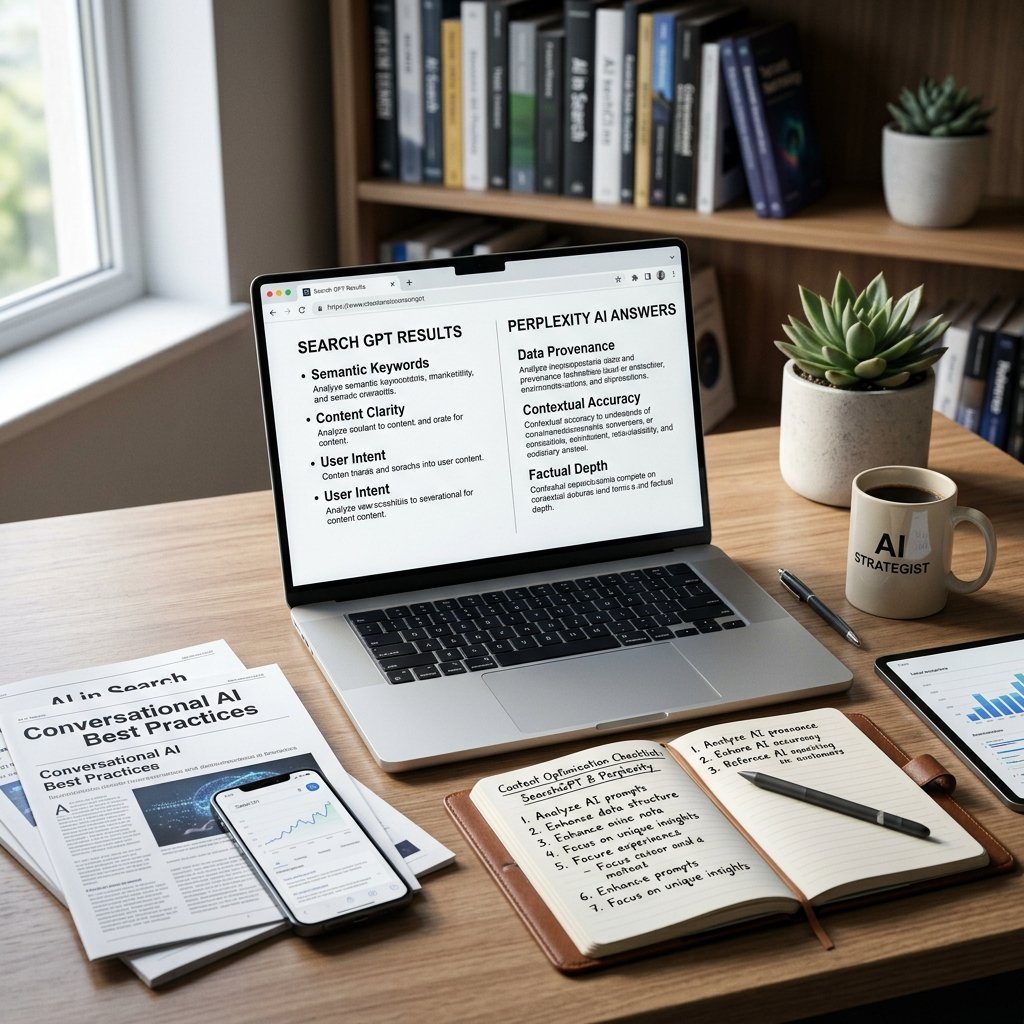
The era of "ten blue links" is rapidly closing. As users migrate toward answer-engines like Perplexity AI, OpenAI’s SearchGPT, and Google’s own AI Overviews, the fundamental mechanics of organic discovery are changing. Users no longer want a list of resources to hunt through; they want a synthesized, direct answer backed by verifiable citations.
For site owners, this introduces a new discipline: Generative Engine Optimization (GEO). The rules that governed traditional SEO—keyword density, massive word counts, and aggressive backlinking—do not directly translate to Large Language Models (LLMs).
If your content is buried behind heavy JavaScript, padded with 500 words of introductory fluff, or lacks hard data, these AI engines will simply skip it and cite your competitors instead. Here is the definitive playbook on how to engineer your site's content to become the primary citation source for AI search engines.
Understanding the AI Search Architecture (RAG)
To optimize for SearchGPT and Perplexity, you must first understand how they work. Both platforms utilize a framework called Retrieval-Augmented Generation (RAG).
When a user asks a question, the LLM doesn't just rely on its internal training data. It executes a real-time web search (often via Bing API or Google API), scrapes the top results, extracts the facts, and synthesizes an answer, appending citations `[1]`, `[2]` to the sources it used.
│ THE RAG PIPELINE WORKFLOW │
├─────────────────────────────────────────────────────────────┤
│ 1. User Prompt ──> "What is the best SEO tool for 2026?" │
│ 2. Retrieval ──> Engine queries Bing/Google index │
│ 3. Scraping ──> Engine downloads text from top 5-10 URLs│
│ 4. Extraction ──> LLM identifies facts, stats, & entities │
│ 5. Generation ──> LLM writes answer citing the sources │
└─────────────────────────────────────────────────────────────┘
Because the engine is scraping and reading your site in milliseconds, machine readability and information density are your most critical ranking factors.
The 3-Part Playbook for Generative Engine Optimization (GEO)
Strategy 1: The "Inverted Pyramid" & Information Density
Traditional SEO taught writers to tease the answer to keep users on the page (increasing dwell time). LLMs hate this. If a parser has to scan through 800 words of "history of the topic" to find the actual answer, it will drop your page from its context window.
How to Execute:
- Direct Answer Blocks: Answer the core intent of the page in the first 50–75 words. Use a bolded "TL;DR" or "Quick Answer" section right under the H1.
- Fact-Heavy Phrasing: LLMs look for nouns, numbers, and definitive statements to use as citations. Replace "Our software is really fast and saves a lot of time" with "Our software reduces Next.js build times by 40% and processes 10,000 rows in 1.2 seconds."
- Eliminate Fluff: Cut introductory sentences like "In today's fast-paced digital world..." RAG models assign relevance scores to chunks of text; fluff dilutes your relevance score.
Strategy 2: Structural Formatting for LLM Parsers
SearchGPT and Perplexity strip away CSS and complex layouts. They look at the raw HTML or a simplified markdown version of your DOM. If your content structure isn't semantically perfect, the AI cannot understand the relationship between concepts.
How to Execute:
- Strict Heading Hierarchy: Use H2s for questions or core topics, and immediately follow them with a concise paragraph or a bulleted list. The H2 serves as the "Question" and the paragraph beneath is the "Answer" for the LLM.
- Tables and Lists: LLMs excel at parsing markdown tables and HTML
<table>elements. If you are comparing tools, prices, or specs, put them in a clean table. Perplexity frequently pulls data directly from tables to build its own comparison grids. - Technical Accessibility: If your content is rendered entirely via client-side JavaScript (e.g., a heavy React SPA without Server-Side Rendering), AI crawlers might see a blank page. Ensure critical content is available in the initial HTML response.
Strategy 3: Engineering Original Data and "Citability"
Why should Perplexity cite your site over a competitor's? Because you have unique data. AI engines are programmed to avoid plagiarism by synthesizing multiple sources, but they heavily favor primary sources that provide original statistics or unique methodology.
How to Execute:
When publishing a guide, include a dedicated section for "Our Methodology" or "Data Points." Mark this up using semantic HTML. When you cite a statistic, the AI will trace it back to you.
<div class="data-citation-block">
  <h3>2026 Core Web Vitals Research Data</h3>
  <ul>
    <li><strong>Sample Size:</strong> 500 E-commerce Domains</li>
    <li><strong>Key Finding:</strong> Sites with INP under 200ms saw a 14% lift in organic traffic.</li>
  </ul>
</div>
Matrix: Traditional SEO vs. Generative Engine Optimization
| Focus Area | Traditional SEO (Google Search) | GEO (SearchGPT / Perplexity) |
|---|---|---|
| Content Structure | Long-form, keyword-optimized narrative | High-density, modular, inverted pyramid |
| Primary Goal | Rank #1 to capture the click | Provide facts to become the primary citation `[1]` |
| Keyword Strategy | Exact match and LSI variations | Semantic entities and definitive statements |
| Trust Signals | Backlink profile (Domain Authority) | First-hand experience, original data, brand authority |
The Unwritten Rules of AI Search Visibility
Optimizing for LLMs requires dropping some old habits. Here is what will actively hurt your chances of being cited by AI engines.
Rule 1: Stop Keyword Stuffing and AI-Generated Filler
Perplexity and SearchGPT use language models to evaluate your text. They can instantly detect low-effort, AI-spun content because it matches their own probabilistic patterns. Human-edited, concise text stands out mathematically.
Rule 2: Update Content Frequently (The Freshness Factor)
Perplexity allows users to filter searches by "Past Week" or "Past Month." If your article is titled "Best SEO Tools 2026" but the last modified date in your schema is from 2024, the RAG system will exclude you in favor of fresher, albeit weaker, content.
Rule 3: Ensure Brand Entity Clarity
AI engines need to know who you are to trust you. Ensure yourOrganizationschema is perfectly implemented, interlinking your site with your branded social profiles, Crunchbase, and GitHub repositories.
Summary Checklist for SearchGPT & Perplexity Optimization
- Add a 50-word "Direct Answer" or TL;DR at the very top of your most important pages.
- Strip out 80% of introductory "fluff" from blog posts; start delivering value immediately.
- Convert complex comparisons or pricing data into raw HTML tables.
- Include original data points, statistics, or case study results that AI can uniquely cite.
- Ensure your content is fully accessible without client-side JavaScript execution (SSR/SSG).
- Update the
dateModifiedschema and visually display the "Last Updated" date on the page.